
LintTrust Certificate Profile Assurance Before the Audit
LintTrust evaluates every certificate in scope against the applicable CABF TLS Baseline Requirements at issuance and at the end of the review period. It turns the results into traceable findings and a review-ready working paper, while keeping professional judgement with the certification authority and the auditor.
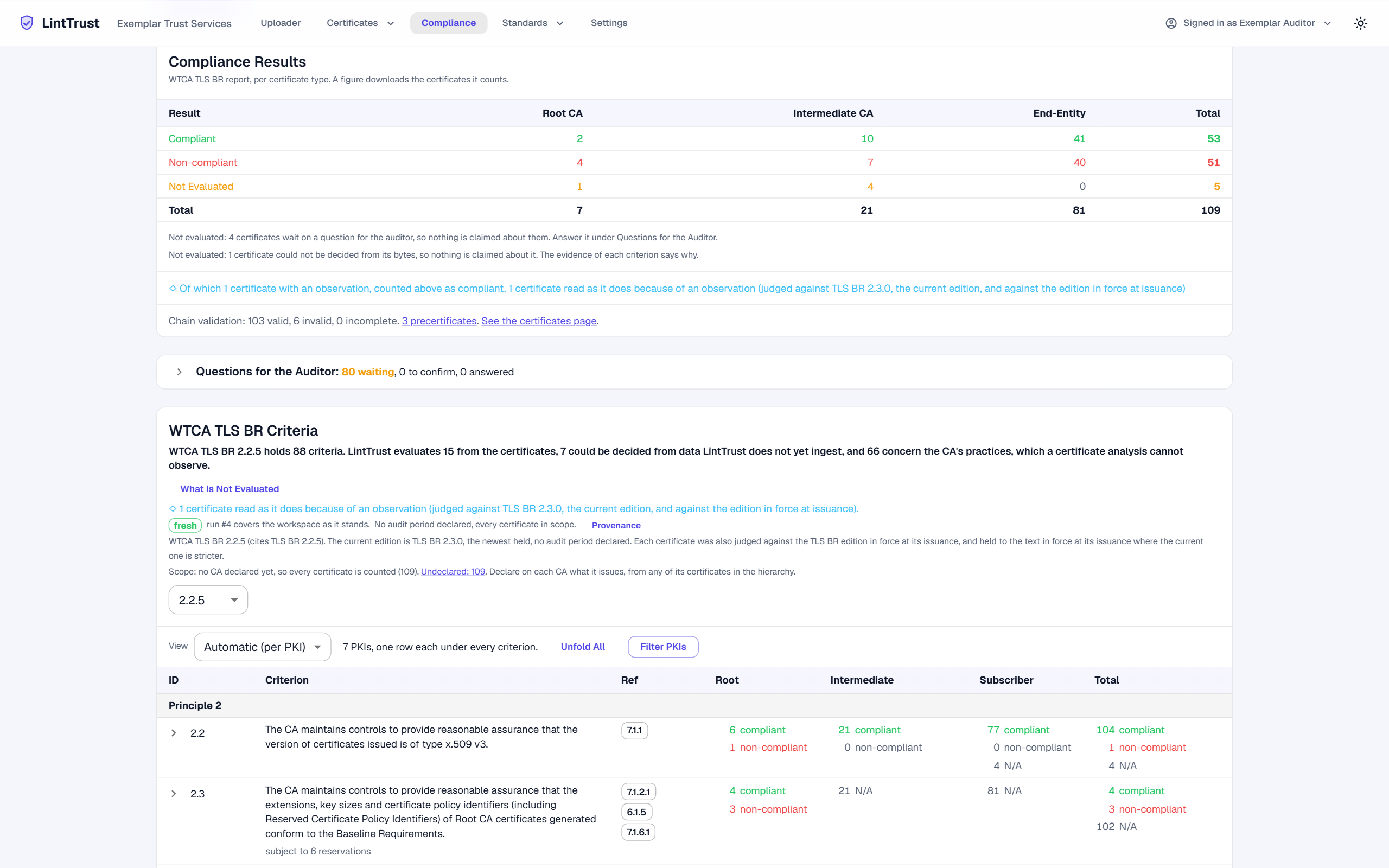

The Exemplar PKI, a fictional CA: 111 certificates uploaded, evaluated, and written up as a WebTrust working paper. English narration, English subtitles.
Loads from YouTube only when you press play.
How It Works
1. Define the Review Scope
Upload a quarterly sample, a complete issued-certificate population, or the certificates generated from a new profile. LintTrust deduplicates certificates by their SHA-256 fingerprint. Repeat uploads do not increase the analyzed population.
2. Apply the Right Requirements
Each unique, valid certificate is evaluated against the supported CABF TLS BR edition in force when it was issued and the edition in force at the end of the review period. Later requirements are identified as later requirements, not silently applied to earlier issuance.
3. Review, Decide, and Export
Results are organized by supported WebTrust criterion, with the applicable CABF clause, the value found, the value required, and the certificate-level proof. Questions that require human judgement remain questions. The final working paper is available in PDF and Word.
Coverage
Focused on What Certificates Can Prove
LintTrust evaluates certificate-decidable requirements. It does not infer facts that certificates cannot establish, such as subscriber validation procedures, operational controls, the implementation of a CP or CPS, or an auditor’s conclusion. Those matters remain explicit questions or clearly identified limits, never silent assumptions.
Historical Requirements, Not Only Today’s Rules
Certificate populations often span several editions of the CABF TLS Baseline Requirements. LintTrust preserves the requirement applicable at issuance and distinguishes it from the requirement applicable at the review-period end.
One Path from Conclusion to Certificate
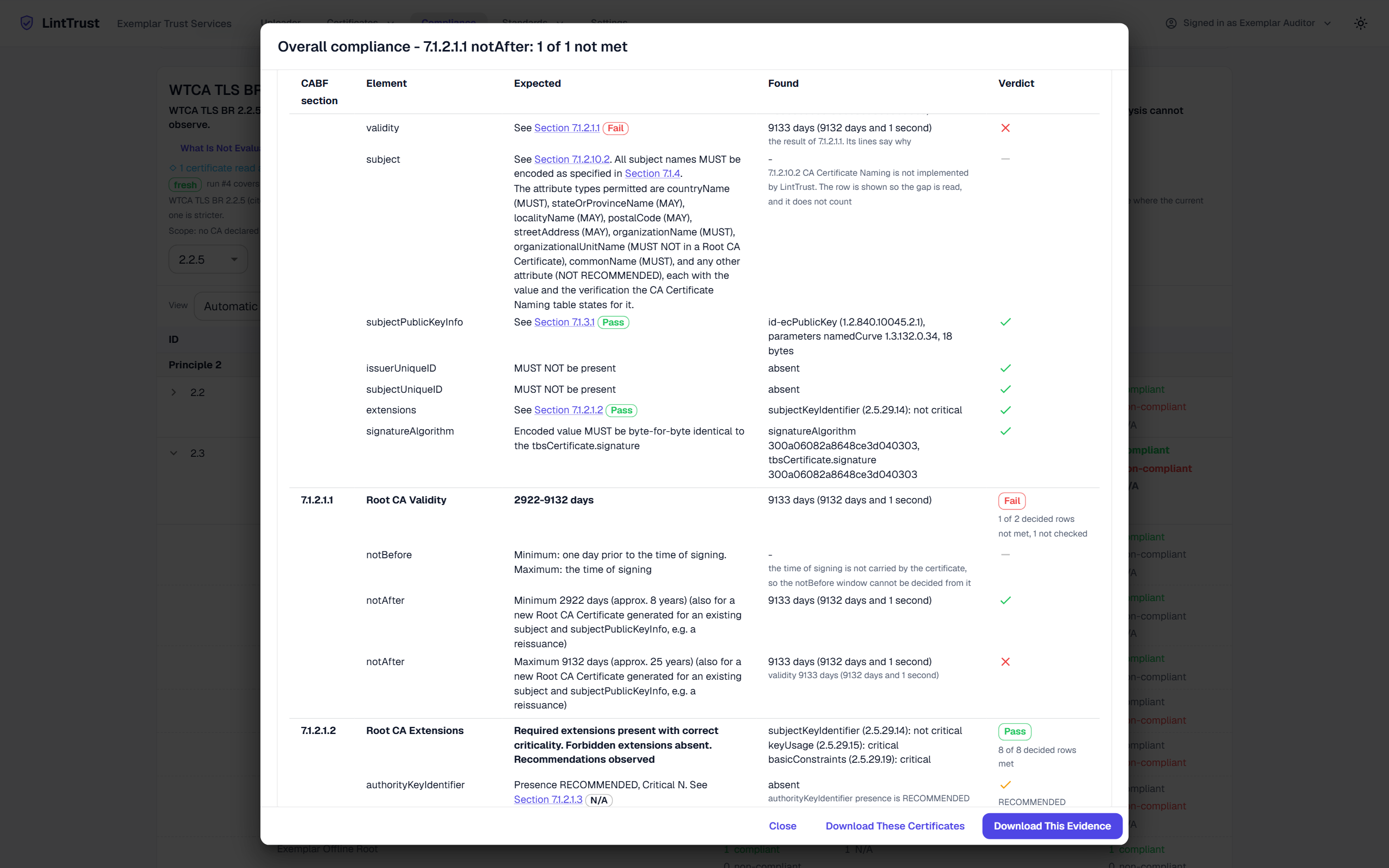
Every supported verdict remains traceable to its criterion, CABF clause, expected value, observed value, certificate, and source bytes.
Beyond Classic Linters
A linter finds implementation-level issues. LintTrust prepares an audit-oriented record.
On the comparison set documented in the LintTrust comparison report:
- 25 non-conformities were not reported by the classic linters. The checks required issuer context, the rest of the workspace, a declared certificate type, or a requirement the linters did not implement.
- 20 linter findings were false findings. Fourteen concerned wildcard names permitted by the applicable CABF TLS Baseline Requirements.
- 195 recommendations were reported as findings. LintTrust keeps a RECOMMENDED statement distinct from a MUST requirement and lets the reviewer apply a stricter interpretation deliberately.
- Historical and profile context remained outside the linters’ view. Root and cross-certificate validity, declared certificate profiles, and requirements on both sides of an effective date require more than a current-rule lint result.
The Working Paper
A Review Record Built from the Certificates Themselves
For each review, LintTrust records the period, the supported editions applied, the results by criterion, the certificate-level proof, the questions awaiting human judgement, and any recorded professional appreciation without changing the underlying verdict.
The working paper can be exported to PDF and Word. It gives the certification authority a structured remediation record and gives the auditor a traceable starting point for the certificate-decidable part of the engagement. LintTrust does not express an audit opinion.
Who It Is For
Certification Authorities
Use LintTrust to review quarterly samples, test a new certificate profile before issuance, investigate an existing population, and prepare the certificate-decidable portion of a pre-audit review.
The result is not another list of lint messages. It is a structured record of what was evaluated, which requirements applied, what passed, what failed, what could not be decided from certificates, and what requires remediation or professional judgement.
Audit Firms
Use LintTrust to apply the same supported reading across engagements, reduce manual cross-referencing, preserve certificate-level traceability, and keep the auditor’s appreciation separate from the tool’s factual verdicts.
LintTrust supports the work. The auditor retains the judgement, the conclusion, and the signature.
Guided Pilot
Evaluate LintTrust on a Real Review Scope
Bring one certificate hierarchy, one representative quarterly sample, or a fictional test population. We define the scope and success criteria before the pilot, review the results together, and close with a documented decision on fit and next steps.
Questions
What Does LintTrust Analyze?
LintTrust analyzes X.509 certificates within an agreed review scope. For capacity and reporting, it counts only unique, valid certificates that are successfully analyzed. Certificate identity is based on the SHA-256 fingerprint of the certificate’s DER encoding. Reuploading the same certificate does not increase the count.
Which Requirements Does It Apply?
LintTrust applies the supported CABF TLS BR edition in force at certificate issuance and the supported edition in force at the review-period end. Results are organized against the supported certificate-decidable WebTrust criteria.
Does LintTrust Replace a Linter?
No. Linters remain useful for fast technical checks, particularly before issuance. LintTrust addresses a different job: historical rule selection, criterion-level organization, certificate-population analysis, traceable proof, human questions, and working-paper output.
Does LintTrust Give an Audit Opinion?
No. LintTrust reports certificate facts and supported rule-based verdicts. The auditor remains responsible for professional judgement, materiality, the audit conclusion, and the signature.
What Can LintTrust Not Decide from Certificates?
A certificate cannot prove how subscriber validation was performed, whether an operational control ran throughout the period, whether a CP or CPS was followed in practice, or whether an exception is material. LintTrust identifies these limits rather than converting them into automated conclusions.
What Comes Out?
The review workspace contains summaries by certificate type and supported criterion, certificate-level results, applicable CABF clauses, observed and required values, questions for human review, recorded appreciations, and exportable PDF and Word working papers.
Where Does It Run?
LintTrust is provided in a customer-isolated hosted environment. Access, retention, deletion, and support arrangements are agreed before onboarding or a guided pilot.
Which Certificates Should I Use for a Pilot?
A representative quarterly sample is usually enough. A new certificate profile, a recent audit sample, or a deliberately constructed test population can also be used. The scope is agreed before any customer material is transferred.
What Does It Cost?
The guided pilot is scoped before it starts. Pricing is agreed per organization with the pilot’s proposal.
How Can I Verify a Verdict?
Each supported verdict is linked to the applicable criterion, CABF clause, expected value, observed value, certificate, and underlying bytes. The comparison report also documents where LintTrust and classic linters differ on the same certificates.
Will Other Standards Follow?
The current product focuses on publicly trusted TLS certificates and the supported certificate-decidable WebTrust criteria. Other certificate types and assurance frameworks remain roadmap items until their coverage is complete and verified.
Request a Guided Pilot
A thirty-minute discovery call and demonstration on the fictional Exemplar PKI, followed by a scoped pilot proposal when there is a suitable use case.
Thank you. You will hear from us within two working days.
Your request could not be sent. Please write to [email protected].